



Crypto markets are seeing a smaller-than-average options expiry on Friday, with roughly 21,000 Bitcoin and 130,000 Ethereum contracts set to roll off, totaling about $2.2 billion.
The scale is modest compared with last week’s outsized event, when 263,000 Bitcoin contracts worth $23 billion expired, reflecting quieter trading during the New Year holiday.
Options Positioning Points to Limited Near-Term Volatility
Traders are betting more on rising prices as Bitcoin options set to expire today favor calls over puts, with the max pain level, where most contracts would expire worthless, around $88,000.
Sponsored
Ethereum options show a similar pattern, with max pain at roughly $2,950. Overall, open interest for both coins has dropped from recent peaks, signaling quieter trading during the New Year period, according to Deribit data.
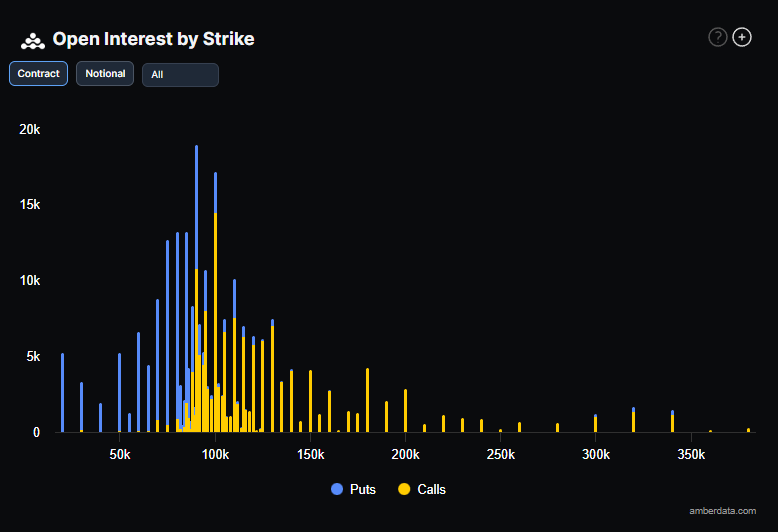
This options expiry is relatively modest, reflecting slower trading during the holiday period and following last Friday’s unusually large event, when about 263,000 Bitcoin options, worth an estimated $23 billion, .
Bitcoin Trades in Tight Range as Volume Thins
Spot trading in Bitcoin and Ethereum was muted on Friday, with Bitcoin hovering near $89,400 and Ethereum climbing back above the $3,000 mark.
Market participants say Bitcoin remains range-bound, supported near $85,000 and facing resistance between $90,000 and $93,000, as thin trading volumes continue to produce choppy price action.
Traders are watching for a decisive move above $90,000 to confirm bullish momentum toward the $95,000–$100,000 range, or a break below $85,000 that could open the door to a deeper pullback toward $75,000–$80,000.
Why This Matters
Options expiry events can amplify short-term price swings, but shrinking open interest and low trading volume suggest this one is unlikely to drive a decisive move on its own.
Dig into Ciphera’s top crypto scoops:
Bitcoin’s 2026 Outlook: Three Scenarios for the Year Ahead
Cardano Sheds 60% in 2025: Will ADA Rebound In 2026?
People Also Ask:
Bitcoin options are financial contracts that give traders the right, but not the obligation, to buy or sell Bitcoin at a specific price by a certain date. They are used to hedge risk or speculate on price movements without owning the underlying Bitcoin.
A trader chooses a call option if they expect the price to rise or a put option if they expect it to fall. They pay a premium for the option, and their profit or loss depends on whether Bitcoin moves above or below the agreed strike price before expiration.
The strike price is the preset price at which the option can be exercised. For call options, profits increase if Bitcoin trades above the strike price; for put options, profits increase if it trades below the strike price.
Bitcoin options are used for hedging, speculation, or generating income through options selling. They allow traders to manage risk while potentially profiting from both upward and downward price movements.
Options can expire worthless, resulting in a total loss of the premium paid. High volatility in Bitcoin markets can lead to rapid gains or losses, making them more suitable for experienced traders.
