
Ethereum (ETH) is drawing renewed attention from institutional investors. BitMine Immersion Technologies, the world’s largest corporate holder of Ethereum (ETH), reportedly has just purchased $418 million in ETH, signaling continued accumulation by big money players.
Despite the large buy, Ethereum’s price has experienced short-term downward pressure, trading around $4,000, down approximately 4.3% over the past 24 hours.
Sponsored
ETH is currently trading just below its short-term averages, signaling a period of sideways movement and some short-term selling pressure. Technical measures suggest the crypto is currently oversold, which could allow for a bounce back toward $4,084 or other nearby resistance levels.
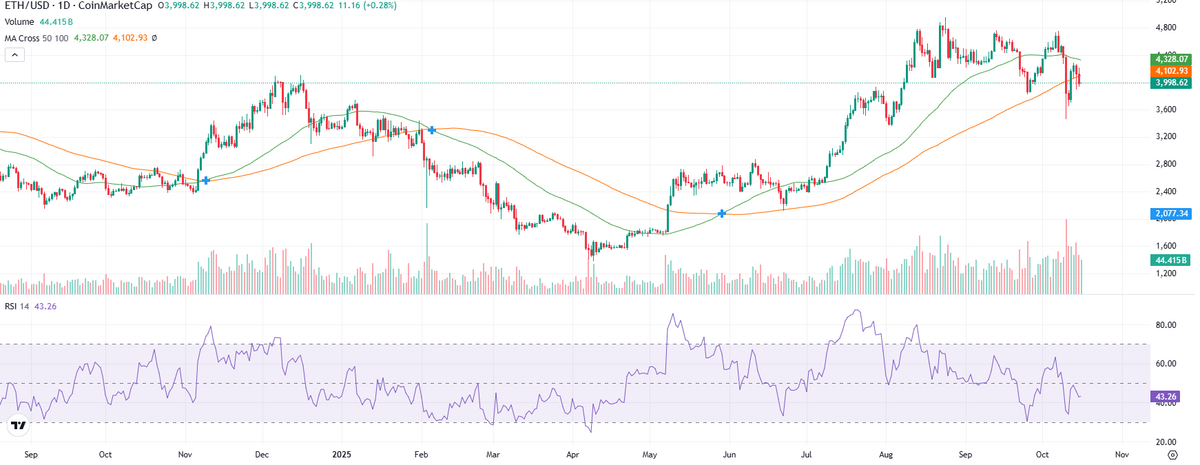
Mid-term indicators, however, continue to favor Ethereum. Its 50-day and 100-day averages sit around $4,390 and $3,707, indicating an overall upward trend.
Market strategist and investor Ted Pillows also highlights the importance of the $3,850 support level, which ETH has held above. Reclaiming $4,250 could trigger a short-term uptrend, while a drop below $3,850 may open the door to further downside volatility.
Why This Matters
ETH may see a near-term correction or bounce, but mid-term momentum remains positive, keeping the cryptocurrency on track for continued upward movement.
Discover Ciphera’s hottest cryptocurrency news:
Stripe’s USDC Boom Hits Coinbase’s Base Chain & Polygon
Bitcoin Enters Late Bull Phase as Short-Term Holders Gain
People Also Ask:
Institutional purchases involve large-scale investors or companies acquiring Ethereum as part of their treasury or investment strategy, often signaling confidence in the asset.
BitMine Immersion Technologies is one of the world’s largest corporate holders of Ethereum, actively acquiring ETH and participating in staking and liquidity protocols.
ETH prices are influenced by supply and demand, market sentiment, regulatory news, technological developments, and large transactions by institutional investors.
An asset is considered oversold when technical indicators suggest it has dropped too quickly, potentially leading to a rebound.
Short-term momentum reflects price trends over days or weeks, while mid-term momentum captures trends over months, guiding trading and investment strategies.