
The decentralized physical infrastructure networks (DePIN) sector is emerging from its speculative phase, showing measurable revenue growth and resilience despite lagging token valuations, states the newest Messari’s State of DePIN 2025 report.
Revenue Growth Signals Real-World Adoption
DePIN networks, which combine blockchain technology with real-world services such as decentralized bandwidth, compute, energy, and sensor networks, now account for an estimated $10 billion in market capitalization.
Sponsored
On-chain revenue for the sector reached $72 million in 2025, signaling that usage and adoption are taking hold.
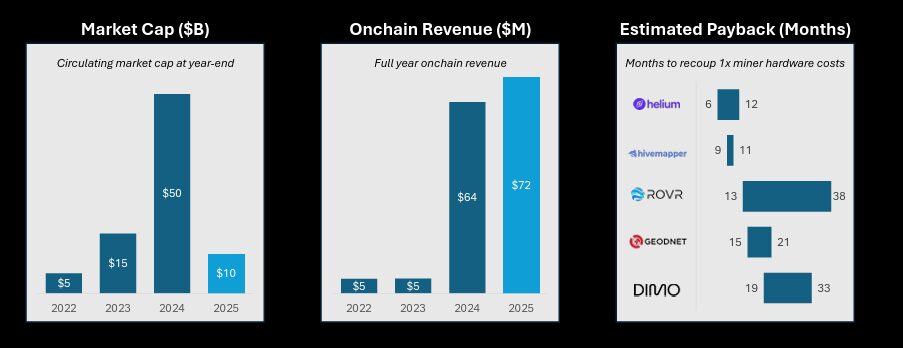
“DePIN has matured from speculative experiments into real, revenue generating infrastructure businesses,” the report states.
Certain networks continue to generate revenue even during broader market downturns, outperforming many DeFi protocols and layer-one blockchains.
Leading projects currently trade at 10–25 times annual revenue, far below the 1,000-plus multiples seen during the 2021 crypto cycle, highlighting a disconnect between real-world usage and token market prices.
Among top DePIN networks, revenues are beginning to decouple from token prices. While much of the $10 billion sector saw token values decline in 2025, a small group of networks generating real-world utility continued to grow on-chain revenue, driven by actual usage rather than speculation.
Sector Dynamics: Compute, Bandwidth, and Energy
The compute sector is the most competitive, with over 50 projects competing and few clear differentiators between them.
Bandwidth networks are likely the hardest to replicate at large scale, giving them the strongest competitive advantage, but achieving global coverage is extremely challenging. Energy-focused DePINs, while the most capital-intensive, often benefit from consistently high margins.
Paths to Sustainable Growth
Messari identifies several realistic pathways for scaling the sector sustainably. In practice, they must either use DeFi-style financing to fund infrastructure (InfraFi), focus on low-cost setups that generate quick returns, or tap into speculative investment during bull markets.
According to Messari, InfraFi is emerging as a new way to finance crypto-backed physical infrastructure.
By tapping into the $175 billion in outstanding stablecoins, early projects show that DePIN networks could be funded with yield-seeking capital. However, the approach is still in its early stages and comes with credit, timing, and regulatory risks.
Reportedly, private investment continues to flow into DePIN networks even as public token prices lag. According to the report, in 2025, startups raised approximately $1 billion, mostly in seed and Series A rounds, reflecting strong long-term confidence from private investors despite public markets pricing in limited survival.
Why This Matters
As DePIN networks expand, the sector is increasingly seen as a bridge between blockchain innovation and physical infrastructure deployment. Its maturation could pave the way for a new class of tokenized infrastructure projects delivering measurable real-world services.
Stay in the loop with Ciphera’s top crypto news:
Bitcoin Slides Toward $81K as Markets Retreat on Risk-Off Fears
XRP’s Millionaire Club Grows Despite Mild Price Dip
People Also Ask:
DePIN (Decentralized Physical Infrastructure Networks) are blockchain-based networks that operate real-world infrastructure, such as bandwidth, compute, energy, or sensor systems.
They generate revenue from actual usage of their services—on-chain fees, subscription models, and incentives for providing infrastructure.
InfraFi is a financing model combining DeFi and DePIN, using stablecoins or yield-seeking capital to fund physical infrastructure projects.
Compute networks are highly competitive, bandwidth networks have strong long-term moats, and energy networks are capital-intensive but profitable.