
Ethereum (ETH) fell below the $3,000 mark today following $165 million in outflows from the BlackRock ETHA ETF on Tuesday.
Overall, ETH ETFs saw a $74 million outflow yesterday, more than half of Monday’s $189 million, marking one of the largest 30-day ETF outflow periods in history, totaling over $1.49 billion, according to SoSoValue’s data.
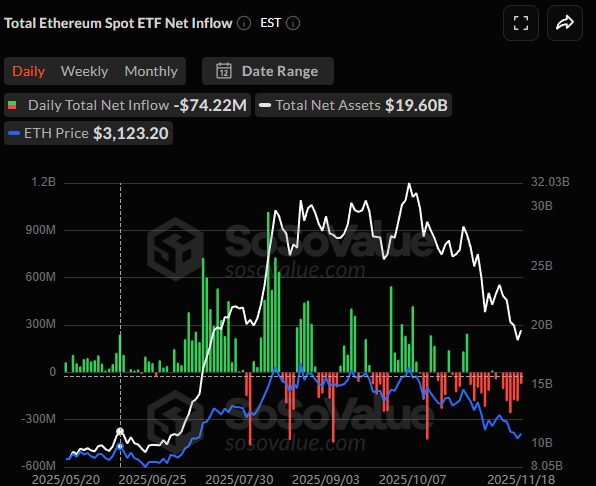
Despite this near-term selling pressure, on-chain data suggests longer-term bullish sentiment. Ethereum reserves on centralized exchanges have dropped by 700,000 ETH over the past month.
Sponsored
Crypto trader Merlijn The Trader noted that such a supply shock often signals potential price volatility, but currently, ETH is being aggressively accumulated, pointing to strong underlying demand.
In the meantime, CME ETH futures reflect mixed sentiment. November contracts fell to $3,083, while December and January futures are slightly higher at $3,097.50 and $3,118.50, indicating a mix of near-term caution and mild forward optimism among traders.
For Ethereum to regain bullish momentum, it needs to climb back above $3,200, with a potential rally toward the $3,400–$3,600 range, analyst Ted Pillows.
Why This Matters
A battle between near-term selling and long-term stacking sets the stage for potential volatility (and opportunity) for Ethereum traders.
Discover Ciphera’s hottest crypto news today:
Panic Rising, Miners Buying: Is Bitcoin Near Its Breaking Point?
Will Bitcoin Bounce or Break? Futures Signal Caution
People Also Ask:
Futures are contracts to buy or sell ETH at a predetermined price on a future date, allowing traders to hedge or speculate on price movements.
Exchange reserves show how much ETH is held on centralized platforms. Lower reserves often signal accumulation, which can reduce liquid supply and support prices.
Significant purchases or sales, such as ETF moves by major firms, can trigger short-term price swings and influence market sentiment.