
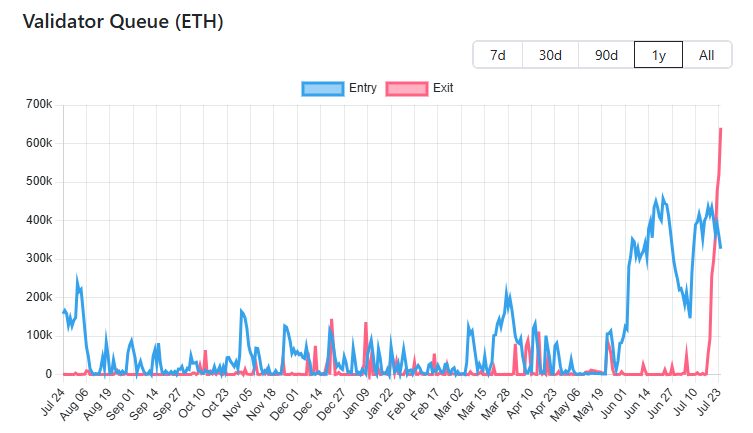
More than 640,000 ETH, worth over $2.32 billion at today’s prices, is lined up to exit Ethereum’s staking system, marking the largest validator exit queue in over a year. But industry insiders say this isn’t a cause for alarm.
ETH Exit Queue Jumps to Record Levels
The number of ETH unstaking requests surged from just under 2,000 to over 640,000 in less than a week, pushing exit wait times from under an hour to more than 11 days, according to data from ValidatorQueue.
Sponsored
In Ethereum’s proof-of-stake system, validators secure the network in exchange for rewards. They do this by staking ETH, locking it up to support blockchain operations. When validators decide to exit, they must wait in a built-in “exit queue,” which limits how many can leave during each epoch to preserve network stability.
That queue now stands at historically high levels, higher even than January 2024, when the previous peak was triggered by the withdrawal of 550,000 ETH during Celsius’s restructuring.
Why This Happened
The sharp rise in the exit queue began on July 16, sparking speculation that validators may be trying to exit in anticipation of a price correction. But according to Galaxy Research associate Lucas Tcheyan, the root cause is more technical than emotional.
The trigger, Tcheyan explains, was a spike in ETH borrow rates on DeFi lending platforms like Aave, where rates jumped from around 3% to as high as 18% between July 16 and 21.
This sudden cost increase made previously profitable ETH looping strategies, where users borrow ETH to re-stake and earn yield, unsustainable.
As a result, many traders were forced to unwind leveraged positions, which led to large-scale redemptions of liquid staking (LST) and liquid restaking tokens (LRT). These tokens began to depeg from ETH, prompting further exits as users sought to regain liquidity or capitalize on arbitrage opportunities between discounted LSTs and full ETH value.
Adding to the congestion, automated vaults also began to exit. Notably, EtherFi’s liquid strategy alone accounts for around 20,000 ETH in the exit queue.
ETH Staking Demand Remains Strong
Despite the wave of exits, Ethereum’s long-term outlook remains strong. Staking demand is rising, and the validator entry queue is also growing, a sign that many are still eager to participate.
Driving this trend is renewed interest from institutional players. Since early July, Ethereum spot ETFs have seen strong inflows from firms like BlackRock and Fidelity, with billions of dollars pouring into the ecosystem.
Why This Matters
Ethereum’s staking system is operating as intended, managing validator inflows and outflows in an orderly way. However, the recent exit spike highlights areas where the liquid staking ecosystem could benefit from improved liquidity tools and infrastructure.
People Also Ask:
Ethereum staking involves locking up ETH to help secure the network in return for earning passive rewards. It’s a key part of Ethereum’s proof-of-stake consensus.
Validators are users who stake 32 ETH (or more via pooled services) and are responsible for processing transactions and maintaining Ethereum’s network integrity.
Ethereum limits the number of validators who can exit per epoch (~6.4 minutes) to protect the network, which can cause delays during high demand.