
Wall Street’s push into tokenized finance is no longer a single-track experiment. Instead, a clearer structure is emerging: two parallel blockchain economies are forming — one permissioned and institutional, the other public and open. At the center of both is an accelerating race over which infrastructure will ultimately power global financial markets.
JPMorgan’s latest move underscores that split. The bank filed with the U.S. Securities and Exchange Commission (SEC) on May 12 to launch its second tokenized money market fund on Ethereum — the JPMorgan OnChain Liquidity-Token Money Market Fund (JLTXX).
Sponsored
The fund will hold short-term U.S. Treasuries and overnight repurchase agreements, allowing token holders to transfer shares peer-to-peer and potentially use them as collateral on public blockchain rails.
The launch follows MONY, JPMorgan’s first tokenized fund, introduced in December 2025. Unlike earlier pilots, JLTXX is explicitly structured to align with emerging regulatory frameworks such as the GENIUS Act, which requires U.S.-regulated stablecoin issuers to hold high-quality liquid assets as reserves. That positioning turns the product into more than an investment vehicle — it becomes potential infrastructure for stablecoin liquidity and settlement systems.
Ethereum Remains the Dominant Public Settlement Layer
Across the broader market, tokenized real-world assets (RWA) have expanded to roughly , with U.S. Treasury-related products making up about $15.9 billion, according to RWA tracking data.
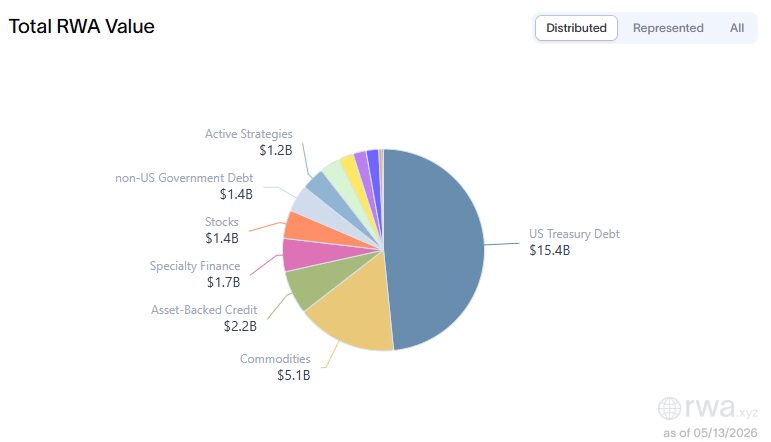
Within that segment, competition is intensifying among major asset managers and financial institutions racing to define the standards of on-chain finance.
BlackRock leads the public blockchain segment through its BlackRock USD Institutional Digital Liquidity Fund (BUIDL), which spans seven blockchains including Ethereum, Solana, and Arbitrum, and manages more than $2.4 billion in assets.
Franklin Templeton’s BENJI follows closely, operating across nine chains such as Stellar, Ethereum, and Polygon, with roughly $2.2 billion in assets and one of the broadest multi-chain footprints in the market.
Ethereum remains the dominant public settlement layer in this segment, hosting about $8.5 billion in RWA assets.
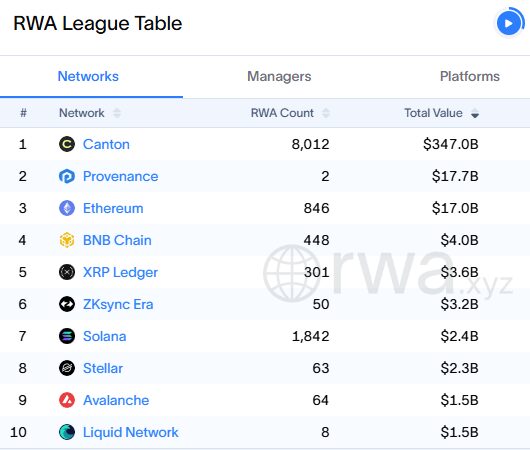
However, if we look at the broader RWA market, Ethereum accounts for about $17.7 billion of the total tokenized asset market and ranks third overall, behind the leading Canton Network ($348 billion) and BNB Chain ($4 billion).
That split highlights the deeper structural divide forming in tokenized finance.
Two Tracks, One Race
On the institutional side, the Canton Network is emerging as a key permissioned blockchain used by major financial institutions, including Goldman Sachs and BNY Mellon. It is designed for regulated financial functions such as post-trade settlement, repo markets, and collateral mobility, operating largely outside public crypto infrastructure.
The Depository Trust & Clearing Corporation (DTCC), which clears nearly every U.S. stock trade and holds custody of over $114 trillion in securities, has also signaled a move toward blockchain-based settlement.
It plans limited live production testing in July, ahead of a broader rollout expected in October, with Canton positioned as a blockchain partner in efforts related to tokenized U.S. Treasury securities.
On the public side, Ethereum and other open networks host tokenized assets that are fully transferable, composable, and increasingly integrated into decentralized finance protocols.
Products such as BlackRock’s BUIDL and Franklin Templeton’s BENJI represent this category, where tokenized Treasuries function as on-chain collateral and liquidity instruments within crypto markets rather than purely institutional ledger entries.
JPMorgan operates across both environments, but through distinct systems. Its MONY fund is issued on Ethereum via Kinexys Digital Assets, the bank’s internal tokenization infrastructure, which is separately integrating its deposit token JPM Coin natively into the Canton Network.
What the GENIUS Act Actually Unlocked
The GENIUS Act has added further momentum to this split, formalizing demand by requiring stablecoin issuers to hold high-quality liquid assets as reserves.
That shift effectively directs capital toward tokenized Treasuries and money market funds that can operate on-chain, particularly on public networks where stablecoin ecosystems already exist.
That is where new products such as JLTXX fit in: bridging regulated Treasury exposure with Ethereum-based infrastructure rather than keeping it confined to closed institutional rails.
What’s at Stake for Crypto
For decentralized finance (DeFi) and crypto markets, the implications are structural. Tokenized Treasury bills are increasingly being used as on-chain collateral, reducing reliance on non-yielding stablecoins and reshaping the economics of lending, borrowing, and liquidity provision.
This also sharpens Ethereum’s role in the evolving system: not as the dominant institutional ledger, but as the primary open settlement layer where TradFi and crypto markets intersect.
The race, however, is far from settled. BlackRock currently leads in public-chain assets under management, Franklin Templeton in multi-chain reach, and Canton in institutional volume.
JPMorgan, operating across all three layers — institutional systems, permissioned networks, and public blockchains — may ultimately be positioned across the widest segment of the emerging tokenized financial stack.
Why This Matters
The market is splitting into two layers: private Wall Street rails with huge volume, invisible, and institutional. And into public crypto rails, which are smaller, but liquid and composable.
Delve into Ciphera’s hottest crypto news today:
Bitcoin Stays Resilient as US Inflation Accelerates to 3.8%
150 Milliseconds: The Number That Could Redefine Solana’s Role in Global Finance
People Also Ask:
It refers to JPMorgan launching tokenized financial products on Ethereum, signaling a shift from purely institutional systems toward public blockchain infrastructure.
They bring traditional safe assets like U.S. government debt onto blockchain rails, making them usable in digital markets and DeFi.
The fund holds short-term U.S. Treasuries and repo agreements, with tokenized shares that can be transferred peer-to-peer and potentially used as collateral on-chain.