
Pi Network’s (PI) Core team have been hammering away to launch the Mainnet version 23, following suit to Stellar Lumen’s (XLM) Protocol 23 upgrade. Having created tens of crypto wallets on the first testnet, each of them was loaded with 100 Pi Coins (PI).
What Pi Coin’s V23 Brings To The Table For Pioneers?
Then, the applied stress test on Pi’s V23 returned near-zero transaction failure rate, testifying that the 60-million strong community’s blockchain is ready for Open Mainnet. Once the second testnet transactions are carried out in an identical fashion, Pi’s V23 mainnet version should be ready for take-off.
For the Pioneers, this does not only solve multiple scalability issues within the network, but also paves the way for quicker migration of their pre-mined Pi Coins (PI). While the community awaits this network upgrade, many are second guessing Pi’s price potential since the lack of crypto exchange listings & plunging trade volumes.
Is Pi Coin Restoring $1 Price Tag Upon Flawless Tests?
Starting off strong with an all-time peak at $2.99 just a week into the initial mainnet version’s launch back in February, Pi Network’s native crypto pulled back heavily, dropping over 92% of this price milestone to retest the lower demand zone of $0.20 this week, now bouncing back to $0.23 resistance levels despite trading volumes below $100 million a day.
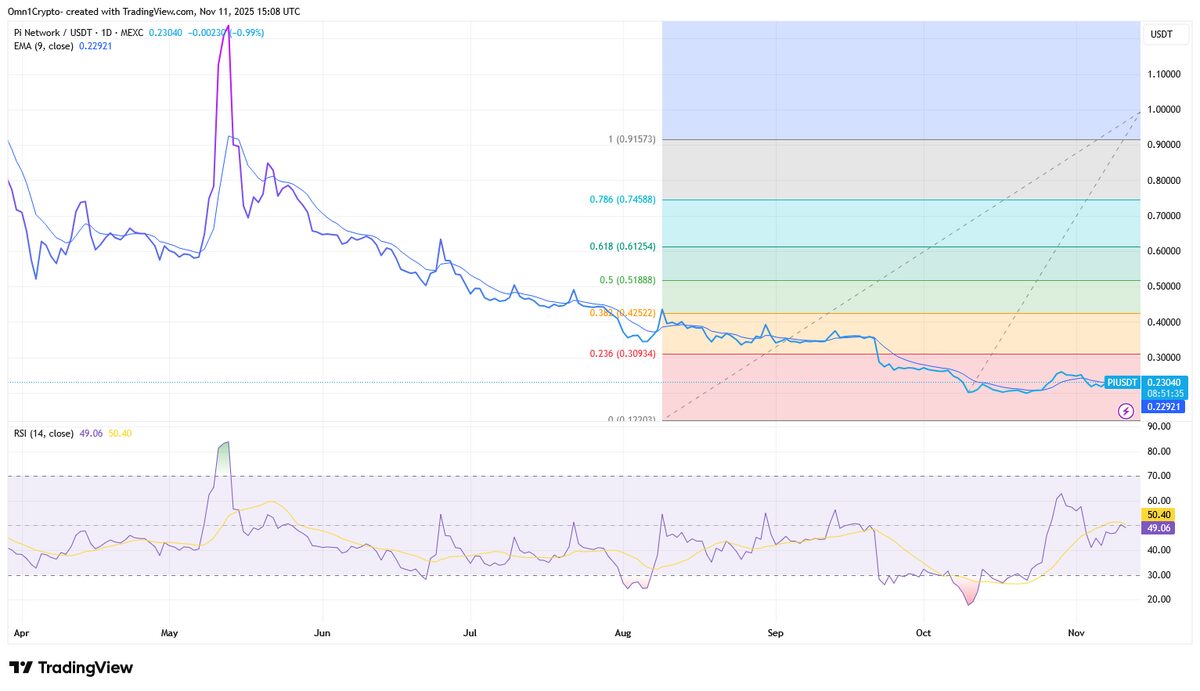
Key on-chain metrics like the Relative Strength Index (RSI) paint a rather neutral picture of the short-term investor sentiment on Pi Coin. However, big-time crypto players, popularly referred to as whales, are still actively taking profits – the Chaikin Money Flow (CMF) flashes a negative -.0.10.
For any chances at growing beyond $1 again, Pi Coin’s (PI) price would have to tackle the 0.618 Fibonacci level first. This mid-point level sits at $0.60, the higher major demand territory that could be flipped into support.
Without the $1 price tag since mid May, Pi Coin (PI) is relying on this bullish cross-over after flipping the Exponential Moving Average (EMA). Notably, this smoothed-out price trend indicator isn’t a bullish signal on its own, requiring confirmation from whales or a sustainable trading demand boost, which is not the case yet.
Delve into Ciphera’s popular crypto news today:
Firelight to Launch XRP Staking Mainnet on Flare in November
European Tech Startups Eye Stablecoins, But Risks Stall Adoption
People Also Ask:
The Pi Coin news piece highlights the recent V23 testnet upgrade on Pi Network’s Open Mainnet, aiming to boost its digital economy with features like on-chain trading, inspired by Stellar Lumens (XLM).
The V23 upgrade integrates Stellar Core v23.0.1 and a Rust-based SDK, modeled after XLM’s Soroban framework, to improve scalability and let users trade without leaving the ecosystem.
Pi Network’s V23 mainnet upgrade borrows XLM’s efficient transaction model and Soroban smart contract tech, aiming to replicate Stellar’s fast, low-cost payments for Pi’s growing user base.
The V23 test success has sparked $1 price hope, but with Pi trading at $0.3595 and past centralization concerns, it depends on mainnet adoption and tokenomics fixes.
With the Open Mainnet launching soon along with 173 dApps from this year’s Pi Hackathon, Pi aims to rival XLM’s ecosystem if it can boost on-chain activity & user trust.