



In the fast-moving world of cryptocurrency, swapping assets can be frustrating. The market remains fragmented, with rates that often differ up to 8% from advertised figures, unexpected KYC requirements surfacing after funds are sent, and users spending excessive time comparing multiple platforms.
Within this environment, Swapzone positions itself as an intermediary tool: an independent, non-custodial crypto aggregator that enables users to compare real-time offers from partner services and select execution routes without directly holding user funds.
Sponsored
Launched around 2019, Swapzone has developed a presence in the aggregation segment. It does not operate as a traditional exchange or decentralized protocol.
Instead, it aggregates offers from more than 18 third-party providers, including ChangeNOW, SimpleSwap, Easybit, Changelly, FixedFloat and others, displaying competing rates in a single interface. Users retain custody of funds throughout the process.
As of early 2026, the platform lists support for more than 1,600 cryptocurrencies and trading pairs, with broader counts sometimes cited depending on integrated liquidity routes.
This review examines how Swapzone functions, its key characteristics, limitations, and positioning within the broader instant-swap market in 2026.
What Is Swapzone and Who Is It For?
Swapzone is an independent crypto comparison platform that allows users to compare rates, estimated execution times, and provider conditions across multiple exchange services in one interface.
The platform is primarily designed for wallet-based users seeking a simplified route for asset swaps without relying on centralized exchanges or navigating decentralized liquidity protocols.
It is often used by cross-chain participants, retail users, and privacy-focused participants who want clarity on KYC requirements before transacting.
Rather than executing trades itself, the platform functions as a comparison layer that aggregates offers from third-party providers and displays relevant parameters such as pricing, execution estimates, provider ratings, and KYC requirements where applicable.
Unlike centralized exchanges such as Binance or Coinbase, Swapzone does not hold user assets. Compared with DEX aggregators like 1inch, it generally routes users toward instant-swap services rather than on-chain liquidity pools.
How Swapzone Works: Step-by-Step Process
Swapzone aggregates live exchange rates from more than 18 integrated providers and presents available swap options across 1,600 assets in real time.
After users select assets, the system ranks offers based on price, estimated execution time, KYC requirements, and OFC (Open Financial Claims) rate, with the most competitive rates shown at the top.
Users can further filter results by best match, fastest provider or best rate, and choose between fixed or floating pricing, which determines whether the final amount is guaranteed or can change with market movements.
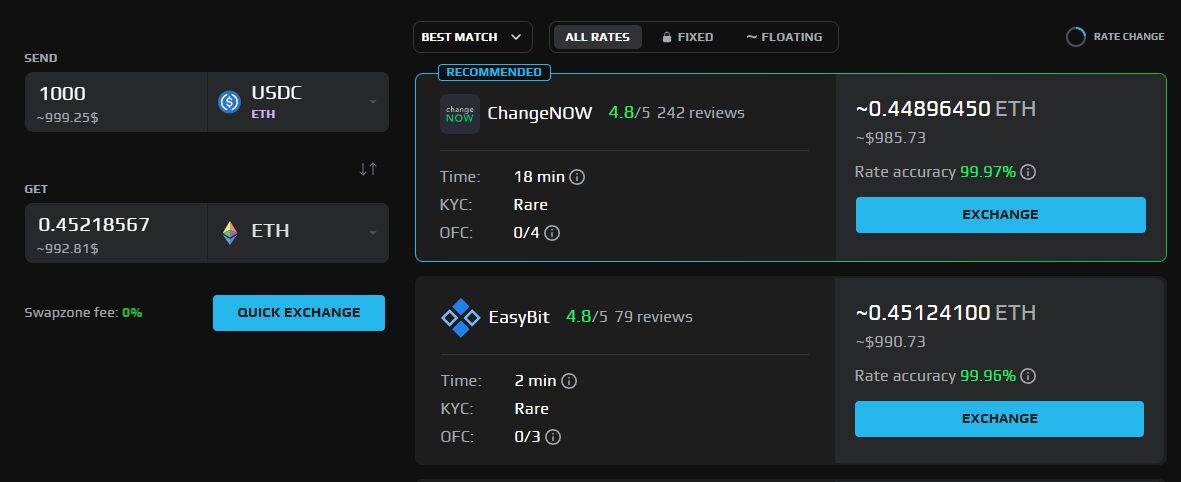
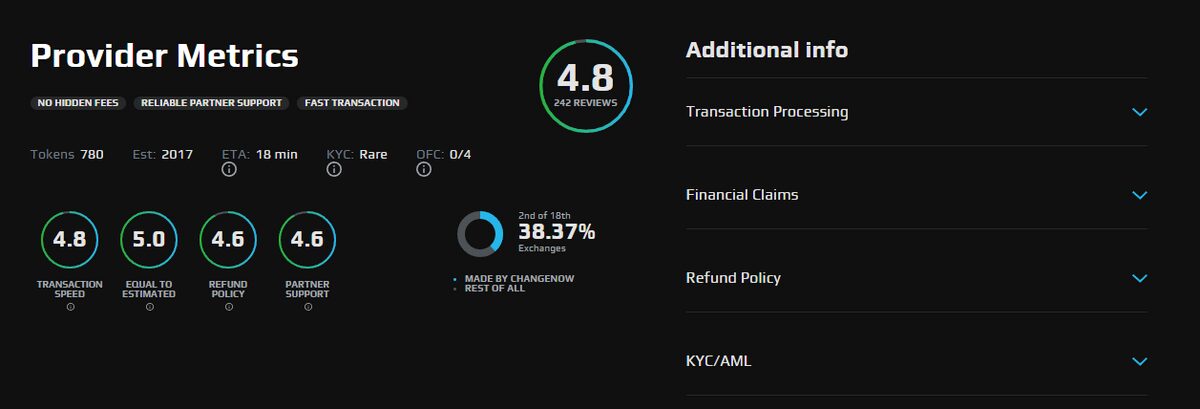
Each provider listing includes additional contextual data such as refund conditions, partner service indicators, and links to external user feedback where available.
If the selected offer is acceptable, users enter a destination wallet and send the specified amount directly from their own wallet to the partner-generated deposit address.
The chosen partner executes the swap, and the recipient receives the output cryptocurrency in their wallet.
Execution times vary depending on the asset pair, network congestion, and the selected provider, ranging from a few minutes to longer settlement windows in less liquid routes.
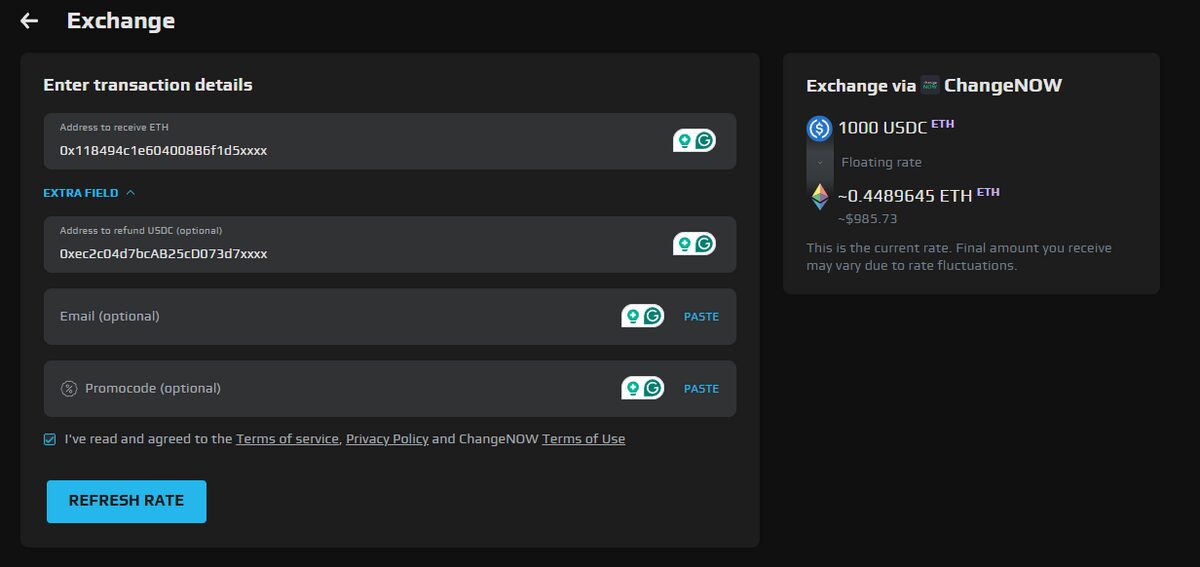
The service operates on a non-custodial basis, meaning Swapzone does not intermediate or store user funds. No registration is required to initiate transactions.
Key Features and Benefits
Beyond basic rate comparison, Swapzone includes several additional functions, including fiat on-ramps that allow users to purchase crypto via credit and debit cards. These flows aggregate multiple providers within a single interface.
Users can choose between fixed- and floating-rate swaps, as well as access additional crypto-related services such as staking, lending, and other third-party financial products, depending on regional availability.
The platform supports routing across multiple execution types, including centralized swap services, cross-chain routes, and P2P pathways.
However, several features are presented as difficult for a single exchange or aggregator to replicate. These include:
- Early asset listings. Some emerging tokens may appear on Swapzone before broader aggregator coverage, depending on provider integration timing.
- Rate and provider visibility. Swapzone presents provider metrics based on transaction data and external user feedback, rather than static listings alone. This includes visible KYC indicators prior to execution, which reduces uncertainty around compliance conditions.
- Support layer. The platform provides multilingual support that assists users in resolving disputes with partner exchanges. Trustpilot reviews often reference responsiveness, although outcomes depend on third-party providers.
Apart from that, Swapzone operates on a 0% platform fee model, meaning that it does not charge users direct fees for swaps. Revenue is typically generated through partner integrations, with costs embedded in quoted rates rather than presented separately. No hidden spreads are added by Swapzone itself. Also no registration is required to use the service.
Reputation and Industry Role
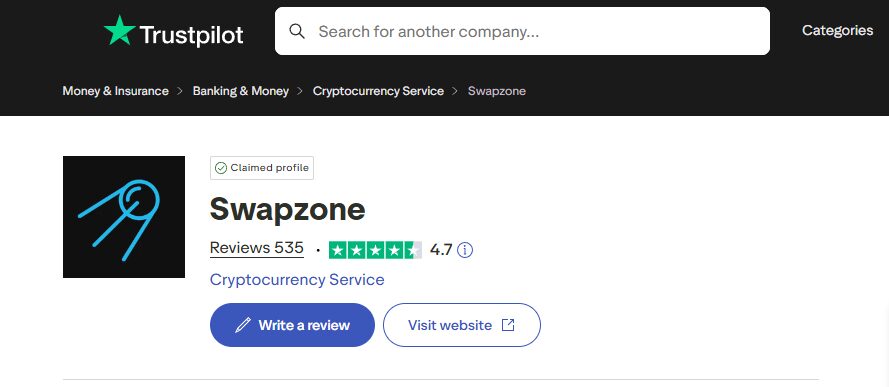
Swapzone maintains a generally positive public reputation within its segment. As of April 2026, it holds a 4.7/5 Trustpilot score based on 535 reviews. User feedback frequently references execution speed, interface clarity, and support responsiveness, although experiences vary depending on provider selection.
The company has also participated in industry benchmarking studies, including data contributions to the Bitcoin.com “Speed Benchmarks: Non-Custodial Swaps Comparison 2026” report.
The study examined 150,000 swap transactions across multiple providers and highlighted meaningful variation in execution times depending on liquidity routes and network conditions. Median completion times across the sector were reported to vary up to 45 times, with faster execution available under optimal conditions.
Security and Risks
While the platform provides aggregation and visibility benefits, its execution model introduces dependencies on external infrastructure.
From a user perspective, considerations are less related to custody risk and more focused on execution variability and counterparty reliance.
- Partner dependency. Speed, final rate accuracy, and support ultimately depend on the chosen provider. This can lead to variability in outcomes across similar transactions.
- KYC variability. Although compliance requirements are displayed before execution, enforcement may still differ depending on jurisdiction and provider policy.
- Asset coverage. Swapzone supports over 1,600 assets and more than 18 exchange partners. While this may not be the broadest coverage, the platform focuses on a strictly vetted set of providers, prioritising quality and reliability over quantity.
Final Verdict
Swapzone earns a 4.7/5 rating as a non-custodial independent crypto aggregator that provides users with comparative visibility into rates, execution options, and provider conditions across a fragmented swap market.
The platform may be particularly relevant for privacy-conscious users and altcoin traders, who want to assess pricing, fees, and provider reputations before execution. The platform supports a broad range of assets, includes early access to new tokens, and transaction-based provider ratings alongside support for disputes with third-party exchanges.
At the same time, execution quality remains dependent on external providers, meaning outcomes such as speed, pricing consistency, and support resolution are not centrally controlled. This makes it better suited to users comfortable with some variability in execution rather than those seeking fully predictable, end-to-end processing.
Overall, Swapzone functions as a useful crypto aggregator in the instant-swap ecosystem, with performance closely tied to the liquidity and reliability of its underlying partners.
