
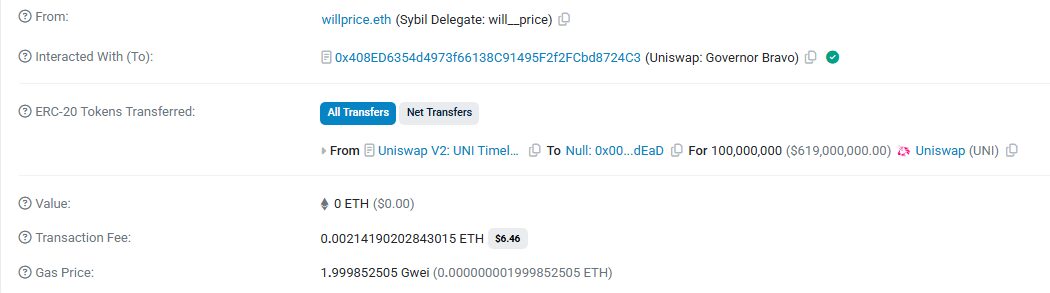
Decentralised exchange Uniswap has permanently removed 100 million UNI tokens worth roughly $596 million from its circulating supply following a decisive governance vote that passed with overwhelming support from token holders.
Sponsored
The burn represents one of the largest single token removals in the decentralized finance (DeFi) to date and marks a significant shift in the protocol’s economic architecture.
Governance Overhaul and Tokenomics Shift
The milestone followed the approval of the “UNIfication” proposal, a governance initiative to activate Uniswap’s long‑anticipated fee switch mechanism.
The vote concluded with approximately 99.9 % of participating UNI holders in favour, with over 125 million UNI votes cast for the change versus only a handful of opposing votes, underscoring broad community consensus.
Under the new structure, a portion of trading fees on Uniswap v2 and selected v3 pools on the Ethereum mainnet is now captured at the protocol level and directed toward ongoing token burns rather than flowing entirely to liquidity providers.
Interface and frontend fees were simultaneously set to zero, reinforcing a shift away from traditional fee models toward a value‑accruing economic framework.
UNI Price Reacted Positively
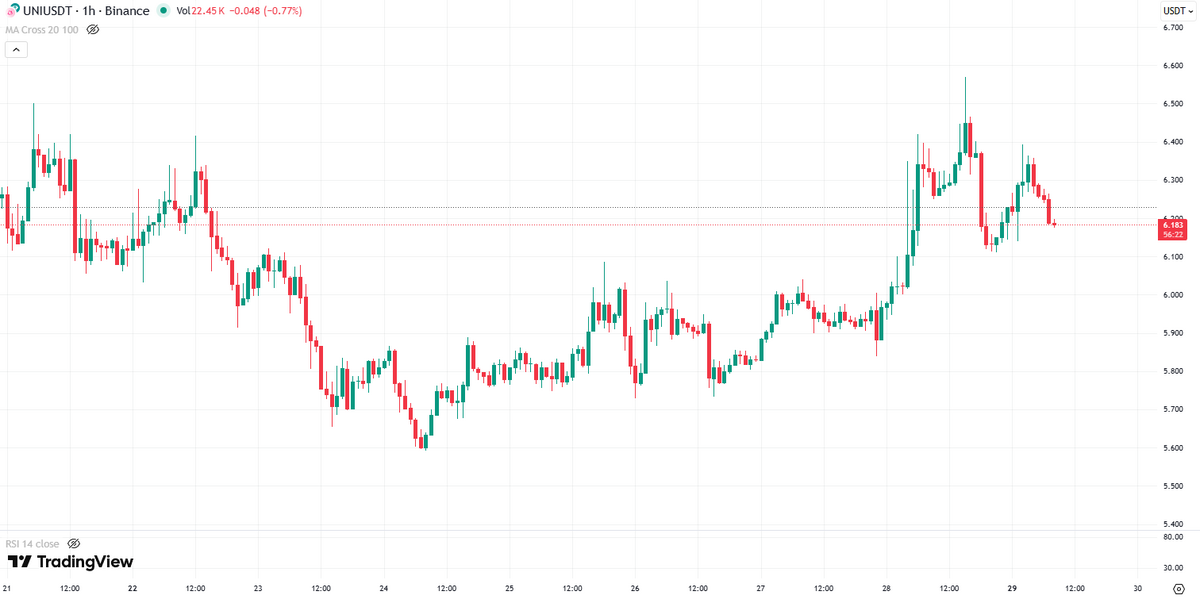
Following the burn, UNI’s price surged nearly 11%, climbing from $5.88 to $6.52 on Sunday, marking its highest level since late November. However, some of those gains faded on Monday, with UNI slipping about 5% to $6.17.
Uniswap ranks among the top DeFi trading platforms, handling around $11 billion in weekly trading volume and producing roughly $580 million in annualized fees, according to DeFiLlama.
Why This Matters
Token burns and governance-driven changes show how DeFi platforms like Uniswap (UNI) can align protocol rules, economics, and community consensus to drive long-term value.
Stay in the loop with Ciphera’s top crypto news:
Prediction Markets: The Internet Crystal Ball That Outperforms Experts
Cardano Boss Dumps X’s Outrage Machine, AI Twin Takes Over
People Also Ask:
A token burn is when a cryptocurrency project permanently removes coins from circulation, reducing supply and potentially increasing scarcity and value.
Uniswap burned the tokens following a governance vote to activate its “fee switch,” aiming to redistribute a portion of protocol fees to token holders indirectly via supply reduction.
A governance vote allows token holders to collectively decide on protocol changes, such as new features, fee models, or tokenomics adjustments.
A fee switch redirects a portion of trading fees collected on a platform from liquidity providers to other purposes, such as token burns or protocol treasury.