
During the latest edition of the U.S. Bank Money 20/20 podcast, dubbed “The Tokenized Future of Banking”. The US Bank revealed to be testing custom stablecoin issuance on Stellar’s DLT chain. The experiment is mainly focused on stablecoin payments and crypto custody, said Mike Villano, Senior Vice President at US Bank.
U.S. Bancorp, one of the leading banking corporations in the United States, has maintained a cautious stance on crypto currency, despite a few positive instances in custody & infrastructure partnerships. With the new deal going live on Stellar Lumens (XLM) chain, U.S. Bancorp is likely to boost XLM’s liquidity, as the market cap difference is enormous.
Stellar: The New Bank-Issued Stablecoin Powerhouse?
Most definitely, the American banking behemoth has $72.64 billion under their belt, while Stellar Lumen’s (XLM) market capitalization revolves around $8.17 billion, a figure 9 times smaller than what US Bank operates on. Still, Stellar’s (XLM) price is still grappling with the $0.25 support line after the pullback from $0.50 yearly heights clenched last Summer.
Sponsored
Dominated by Ethereum, other alts are making a name for themselves in the stablecoin game this year. Ripple (XRP), another ISO 20022 compliant token that’s rivaling XLM, launched their own RLUSD stablecoin as the regulatory headwinds turned positive. For Stellar Lumens, the entrance to the stablecoin market has been nothing short of turbulence.
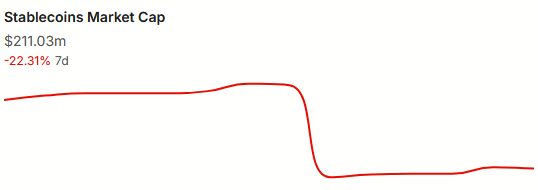
For now, Stellar’s Distributed Ledger Technology (DLT) network has a $211 million market cap in terms of stablecoins, DefiLlama’s data says. Circle USD (USDC) is unanimously dominating the Stellar chain with 94.23% of all trades, so US Bank’s testing on Stellar is likely to substantially bolster the OG chain’s utility in case of successful custom stablecoin testing.
Delve into Ciphera’s popular crypto currency news:
Is DAT Boom Collapsing? All Eyes on MSCI’s Deadline
VanEck: BTC Maxis Flock To Zcash Quantum Shield
People Also Ask:
U.S. Bancorp (America’s fifth-largest bank) kicked off a pilot program on November 25, 2025, to test issuing its own “bank-grade” dollar-backed stablecoin on the Stellar (XLM) blockchain. They’re partnering with PwC and the Stellar Development Foundation to explore how this tech can handle compliant, efficient payments for clients.
Stellar stood out for its built-in compliance tools—like the ability to freeze assets, reverse transactions, and meet KYC rules right at the protocol level. Plus, it boasts 99.99% uptime over a decade, making it reliable for big-bank operations.
The pilot lets U.S. Bancorp issue and manage a custom stablecoin pegged 1:1 to the U.S. dollar, backed by reserves they custody. It’s aimed at institutional use cases like faster cross-border transfers, tokenized deposits, and programmable money—think seamless, low-cost moves without traditional banking delays.
XLM jumped about 3% up in the hours after the announcement, trading around $0.25 as of November 26, 2025, with trading volume spiking 25%. It builds on Stellar’s momentum from partnerships like PayPal’s PYUSD stablecoin launch earlier this year, pushing total value locked (TVL) past $150M.
This is a huge win for regulated blockchain adoption—showing major banks can use public networks like Stellar for stablecoins without ditching compliance. It could speed up tokenized finance, compete with giants like USDC or USDT, and boost XLM’s utility. If the pilot succeeds, expect more banks to follow.