
Stellar (XLM) has strengthened its position as a leading blockchain for real-world assets (RWAs), hosting more than $533 million in tokenized assets, says the recent Messari analysis.
The network now offers access to more than $3 billion in real-world assets, including stablecoins, through an expanding list of issuers.
Sponsored
The move underscores Stellar’s role in connecting traditional finance with DeFi, providing near-zero transaction costs, programmable compliance, and support for both retail and institutional users.
U.S. Treasuries Dominate Stellar’s RWA Assets
Tokenized U.S. Treasuries dominate Stellar’s RWA ecosystem, accounting for 94.8% of the market, according to Messari’s report.
Franklin Templeton’s BENJI token, launched on Stellar in April 2021, tops the segment with a market cap of $496.3 million and 906 holders. BENJI represents shares of Franklin Templeton’s on-chain U.S. Government Money Fund (FOBXX), which primarily invests in government securities and cash.
Other U.S. Treasury offerings on Stellar include WisdomTree’s seven tokenized funds and Ondo Finance’s U.S. Dollar Yield Token (USDY), all designed to deliver yield while remaining compatible with DeFi protocols.
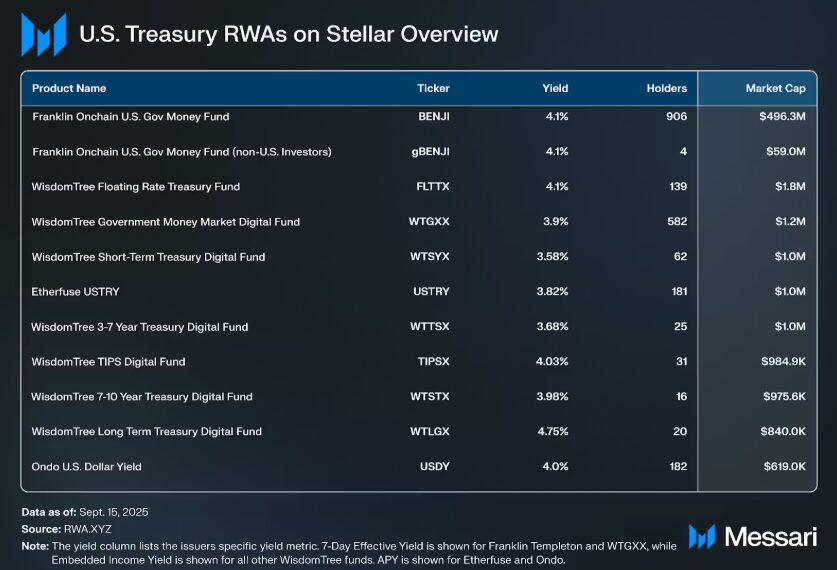
Source: Messari
Stellar Expands Beyond U.S. Treasuries
Stellar’s RWA ecosystem also include equities, real estate, and non-U.S. debt. WisdomTree offers tokenized equity funds, Mercado Bitcoin plans $200 million in tokenized assets, and RedSwan Digital has tokenized $100 million in properties.
Non-U.S. debt is covered by Etherfuse’s CETES and TESOURO funds, while other offerings include corporate bonds, alternative funds, and commodities like tokenized gold (WTGOLD).
DeFi-Ready Assets Drive Stellar’s Growth
Stellar is emerging as a key platform for real-world assets that can be used directly in DeFi. Projects like Centrifuge and Etherfuse are enabling tokenized assets to be freely transferable, while upcoming protocols such as Kinetic and Templar aim to allow overcollateralized lending and borrowing using these assets as collateral.
As per Messari’s report, the network’s expansion is backed by a strong infrastructure layer. Regulated platforms, including Archax, 21X, Bitbond, Cashlink, and Tokenforge, support token issuance and secondary trading. Oracles and interoperability tools from Band Protocol, Redstone, LayerZero, and Axelar help ensure that these assets integrate seamlessly with DeFi applications.
Stellar is positioning itself as a serious player in the global race for RWA adoption. Analysts at Messari highlight the network’s low fees, strong infrastructure, and regulatory compliance as key advantages.
Why This Matters
With new asset classes coming online and institutional partnerships growing, Stellar (XLM) is aiming to compete with major chains like Ethereum (ETH) and Solana (SOL).
Discover Ciphera’s hottest cryptocurrency news:
BitMine Adds $418M in ETH as Crypto Faces Short-Term Dip
Stripe’s USDC Boom Hits Coinbase’s Base Chain & Polygon
People Also Ask:
Stellar (XLM) is a blockchain network designed for fast, low-cost cross-border payments and the issuance of digital assets, including stablecoins and tokenized real-world assets (RWAs).
Stellar enables tokenization of financial instruments such as U.S. Treasuries, equities, corporate bonds, real estate, and commodities, making them accessible on-chain for retail and institutional investors.
Tokenized assets on Stellar offer near-zero transaction fees, global accessibility, programmable compliance, 24/7 liquidity, and compatibility with DeFi applications for lending, borrowing, and yield generation.
Platforms like Centrifuge and Etherfuse allow tokenized assets to be freely transferable, while upcoming protocols such as Kinetic and Templar enable overcollateralized lending and borrowing using these assets as collateral.
Stellar combines low fees, fast settlement, regulatory compliance, and robust infrastructure, positioning it as a competitive hub alongside Ethereum and Solana for tokenized real-world assets.